

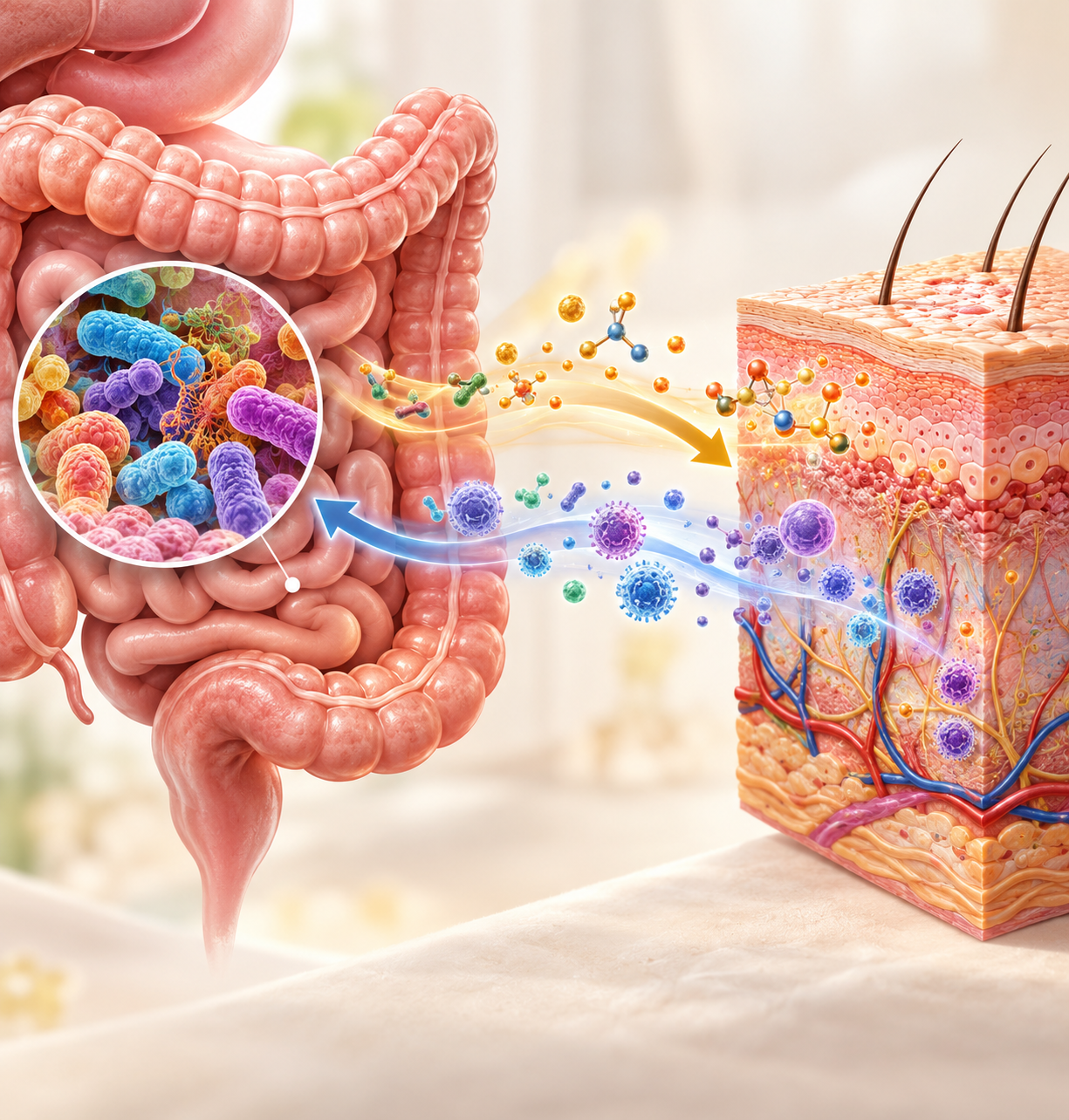
When your skin breaks out, becomes irritated or suddenly feels more reactive, it is natural to look at what is happening on the surface. But scientists are increasingly investigating another part of the picture: the gut.
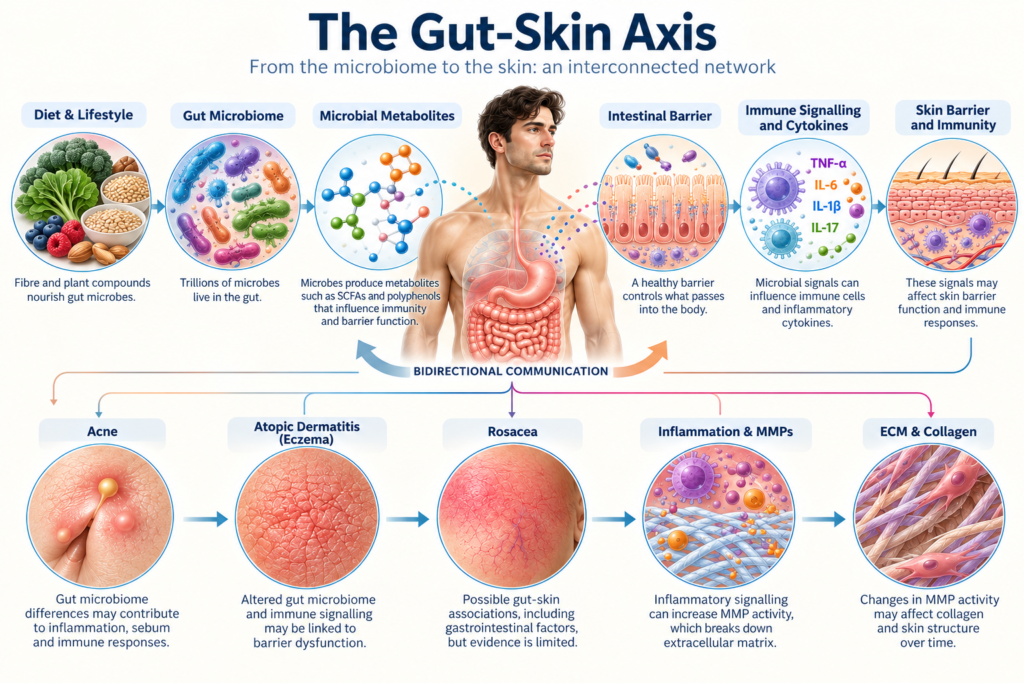
The digestive tract contains trillions of microorganisms collectively known as the gut microbiome. These microbes interact with the intestinal barrier, produce biologically active compounds and communicate with the immune system. Research suggests that microbial metabolites, intestinal-barrier biology and immune signalling may influence processes in distant tissues, including the skin [1,2].
This communication network is known as the gut-skin axis.
It does not mean that every breakout, rash or skin condition begins in the gut. Instead, emerging research points to a more complex relationship involving the microbiome, microbial metabolites, intestinal barrier function and immune signalling.
What Is the Gut-Skin Axis?
The gut and skin may appear very different, but they share an important feature: both are barrier organs.
The intestinal lining regulates interactions between food, microbes and the body’s internal environment, while the skin provides a physical and immunologically active barrier against the outside world. Both also support microbial communities and communicate closely with immune cells [1,2].
Researchers use the term gut-skin axis to describe the pathways through which these systems may influence one another.
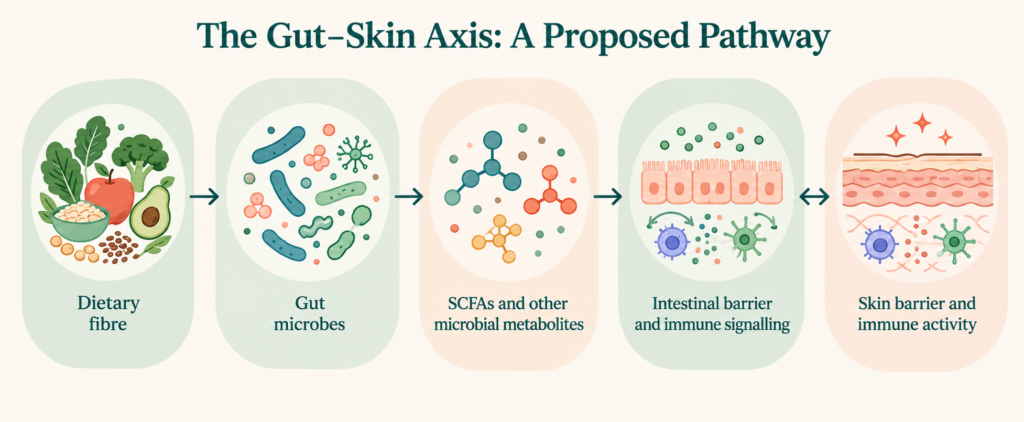
One possible route involves substances produced by intestinal microbes. When certain bacteria ferment dietary fibre, for example, they produce short-chain fatty acids (SCFAs) such as acetate, propionate and butyrate. These microbial metabolites can influence immune and barrier-related processes [2,3].
The relationship therefore looks less like a simple gut-to-skin switch and more like an interconnected biological network.
From Inflammation to the Extracellular Matrix
The gut-skin story may extend beyond visible inflammation to the structural environment surrounding skin cells.
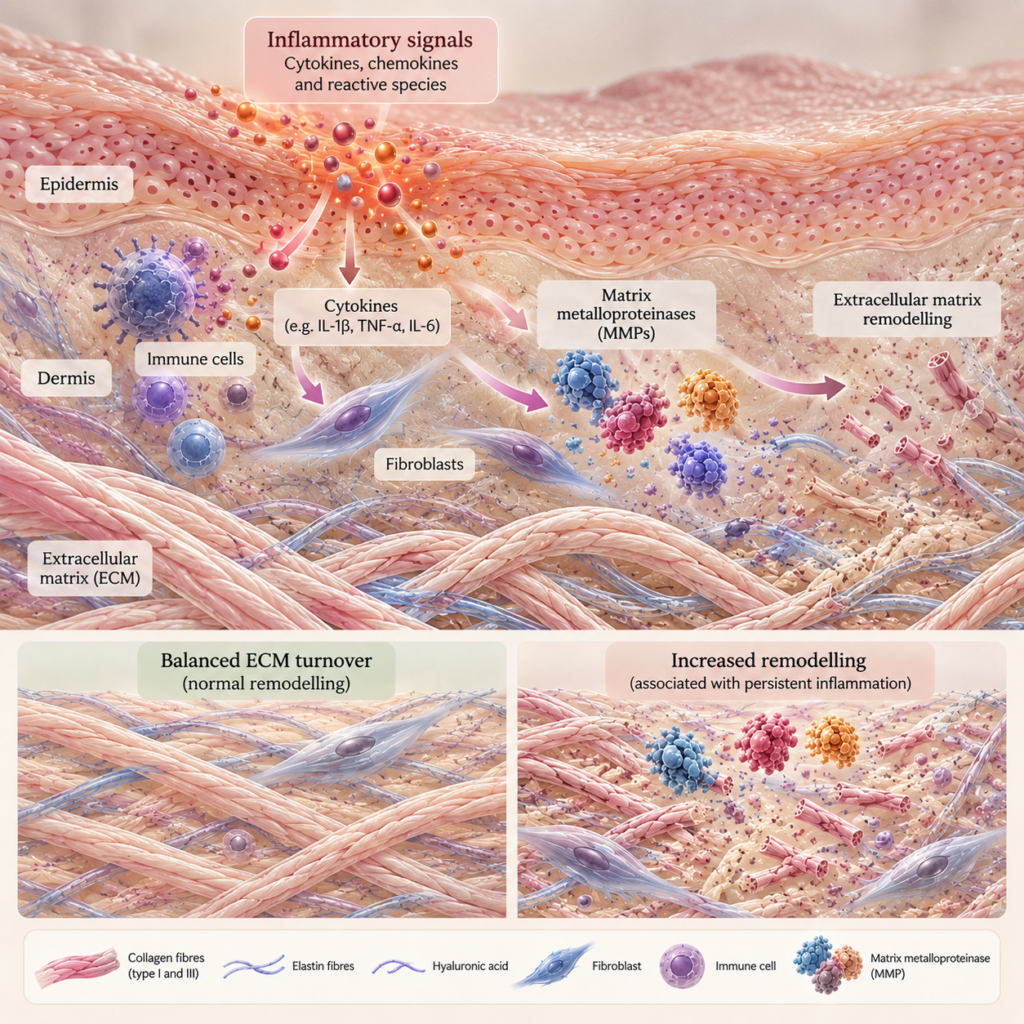
This environment is known as the extracellular matrix (ECM). It contains proteins and other molecules that provide structural support to tissues. Collagen is one of the major structural proteins within the skin’s dermal ECM.
The ECM is continuously remodelled. A family of enzymes called matrix metalloproteinases (MMPs) helps break down extracellular-matrix components as part of normal processes such as tissue repair and remodelling [8].
Inflammatory signalling can influence the expression and activity of MMPs. When MMP activity becomes excessive or poorly regulated, greater degradation of ECM components can occur. MMP dysregulation has been investigated in inflammatory skin disorders as well as skin ageing and photoageing [8,9].
Inflammatory signalling → altered MMP activity → ECM remodelling → changes in structural components, including collagen
There is an important scientific boundary, however. Current evidence does not allow us to say that gut dysbiosis directly causes collagen breakdown in human skin. The connection between inflammation, MMPs and the ECM is well established in skin biology, but the complete microbiome-to-collagen pathway requires further human research.
That raises another fascinating question: what actually determines whether our skin produces, maintains or loses collagen over time?
Can Food Support the Gut-Skin Axis?
There is no scientifically established “gut-skin diet.” However, what we eat can influence the intestinal microbiome and its metabolic activity.
Fibre-rich foods such as vegetables, fruits, legumes, whole grains, nuts and seeds provide substrates that intestinal microorganisms can ferment, including substrates involved in short-chain fatty acid (SCFA) production [3,10]. Practical examples include:
- Legumes: lentils, chickpeas, kidney beans, black beans and peas.
- Whole grains: oats, barley, brown rice, whole-wheat bread and whole-grain cereals.
- Fibre-rich vegetables: artichokes, onions, garlic, leeks, broccoli, carrots and leafy greens.
- Fruits: apples, pears, bananas, berries, oranges and kiwi.
- Nuts and seeds: almonds, walnuts, pistachios, chia seeds, flaxseeds and pumpkin seeds.
Plant foods also contain polyphenols, naturally occurring compounds that interact bidirectionally with the microbiome. Gut microorganisms can transform polyphenols into smaller metabolites, while polyphenol-rich foods may also influence microbial composition and activity [10]. Examples of foods rich in polyphenols include berries, grapes, cherries, plums, apples, cocoa or dark chocolate, extra-virgin olive oil, green or black tea, coffee, herbs, spices, walnuts and colourful beans.
Some fermented foods contain live microorganisms, while others provide fermentation-derived compounds. Examples include yogurt with live and active cultures, kefir, kimchi, sauerkraut, miso, tempeh and certain fermented pickles. Processing matters: heat treatment or pasteurisation can reduce or eliminate live microbes, so a fermented food should not automatically be assumed to contain live cultures.
Probiotics require additional caution. Scientifically, a probiotic is a specific live microorganism at an adequate dose that has demonstrated a health benefit; not every fermented food, yogurt or supplement meets that definition. Look for a clearly named genus, species and strain on a product label—for example, Lacticaseibacillus rhamnosus GG, Bifidobacterium animalis subsp. lactis BB-12 or Saccharomyces boulardii—rather than relying only on a broad “probiotic” claim. Evidence for one strain or strain combination cannot automatically be applied to another product.
Research involving probiotics in acne and atopic dermatitis is encouraging in selected studies, but probiotics should not replace established dermatological treatment [4,5]. A varied, fibre-rich dietary pattern is a sensible basis for overall health and supports microbial fermentation in the colon. However, it should not be presented as a substitute for evidence-based dermatological care, and restrictive diets should not be adopted unless they are clinically appropriate.
A Simple Gut-Supportive Plate
For everyday meals, this could look like oats with berries and walnuts at breakfast; a lentil-and-vegetable meal with brown rice at lunch; and a dinner built around vegetables, beans or chickpeas, whole grains and extra-virgin olive oil. If tolerated and preferred, yogurt with live cultures or kefir can be included as one food option—not as a skin treatment.
Your Skin Is More Than a Reflection of Your Gut
The gut-skin axis is changing how researchers think about the relationship between barrier organs, microorganisms and immunity.
But perhaps its most useful lesson is not that every skin problem needs to be “fixed from within.” Instead, it demonstrates how interconnected human biology can be.
Skin health can be influenced by genetics, hormones, immune function, sun exposure, environmental factors, stress, sleep, diet, medications, skincare practices and underlying health conditions, alongside microbial factors.
Supporting gut health through a varied, fibre-rich diet may contribute to overall health, but persistent acne, eczema, rosacea or unexplained skin changes deserve appropriate assessment rather than automatically being attributed to the microbiome. Seek timely clinical advice, particularly when symptoms are severe, rapidly changing, painful, infected-looking or accompanied by broader symptoms.
The science of the gut-skin axis is still developing. For now, it provides a useful framework for understanding how microbial metabolites, biological barriers and immune signals may connect two parts of the body that once seemed completely separate.
FAQs
Can poor gut health cause acne?
Differences in gut microbial composition have been reported in people with acne, and probiotics are being investigated as supportive interventions. However, acne has multiple established contributors, and current evidence does not show that an unhealthy gut is a single direct cause.
Can probiotics improve skin?
Certain probiotic strains have shown promising effects in studies involving acne and atopic dermatitis, but results vary according to the strain, condition, formulation and individual. Evidence for one probiotic cannot automatically be applied to another, and probiotics should not replace established medical treatment.
Does “leaky gut” cause skin problems?
Increased intestinal permeability is a legitimate scientific concept and is being investigated within the gut-skin axis. However, it should not be assumed to be the cause of every inflammatory skin condition, breakout or unexplained rash.
Which foods support the gut microbiome?
A varied diet containing fibre-rich plant foods can provide substrates for microbial fermentation. Fruits, vegetables, legumes, whole grains, nuts and seeds also provide nutrients and plant compounds that interact with the intestinal microbiome.
A Personal Note
As a biotechnology researcher, I find the gut-skin axis particularly interesting because it demonstrates how rarely biological systems operate in isolation. What interests me most is not the popular idea that the gut “controls” the skin, but the emerging evidence that microbial metabolites, immune signalling and barrier biology may allow distant organs to communicate.
As this field develops, distinguishing promising biological mechanisms from proven clinical effects will remain essential.
Medical Disclaimer
This article is for general educational purposes only and does not replace medical advice, diagnosis or treatment. Consult a qualified healthcare professional for personalised advice, particularly if you have persistent, worsening, painful or unexplained skin symptoms; are pregnant or breastfeeding; manage a health condition; or take prescription medication.
About the Author
Dr. Fatima Khalid is a PhD Biotechnology with experience in molecular biology, cancer research, biomarkers, targeted drug delivery and scientific literature analysis. Her writing for Winsora focuses on translating biomedical research into clear, evidence-based health information for everyday readers.
References
1. De Pessemier B, Grine L, Debaere M, Maes A, Paetzold B, Callewaert C. Gut-Skin Axis: Current Knowledge of the Interrelationship between Microbial Dysbiosis and Skin Conditions. Microorganisms. 2021;9(2):353. doi:10.3390/microorganisms9020353.
2. Sinha S, Lin G, Ferenczi K. The skin microbiome and the gut-skin axis. Clinics in Dermatology. 2021;39(5):829-839.
3. Trompette A, Pernot J, Perdijk O, et al. Gut-derived short-chain fatty acids modulate skin barrier integrity by promoting keratinocyte metabolism and differentiation. Mucosal Immunology. 2022;15(5):908-926. doi:10.1038/s41385-022-00524-9.
4. Boby A, Lee G, Natarelli N, Correa L. Using probiotics to treat acne vulgaris: systematic review. Archives of Dermatological Research. 2024;316(4):101. doi:10.1007/s00403-024-02836-1.
5. Díez-Madueño K, de la Cueva Dobao P, Torres-Rojas I, et al. Gut Dysbiosis and Adult Atopic Dermatitis: A Systematic Review. Journal of Clinical Medicine. 2025;14(1):19. doi:10.3390/jcm14010019.
6. Daou H, Paradiso M, Hennessy K, Seminario-Vidal L. Rosacea and the Microbiome: A Systematic Review. Dermatology and Therapy. 2021;11(1):1-12. doi:10.1007/s13555-020-00460-1.
7. Rainer BM, Thompson KG, Antonescu C, et al. Diversity and Composition of the Skin, Blood and Gut Microbiome in Rosacea: A Systematic Review of the Literature. Microorganisms. 2020;8(11):1756. doi:10.3390/microorganisms8111756.
8. Saarialho-Kere UK. Matrix metalloproteinases in skin. Experimental Dermatology. 1998;7(2-3):69-76.
9. Pittayapruek P, Meephansan J, Prapapan O, Komine M, Ohtsuki M. Role of matrix metalloproteinases in photoaging and photocarcinogenesis. International Journal of Molecular Sciences. 2016;17(6):868. doi:10.3390/ijms17060868.
10. Cardona F, Andrés-Lacueva C, Tulipani S, Tinahones FJ, Queipo-Ortuño MI. Benefits of polyphenols on gut microbiota and implications in human health. Journal of Nutritional Biochemistry. 2013;24(8):1415-1422. doi:10.1016/j.jnutbio.2013.05.001.
